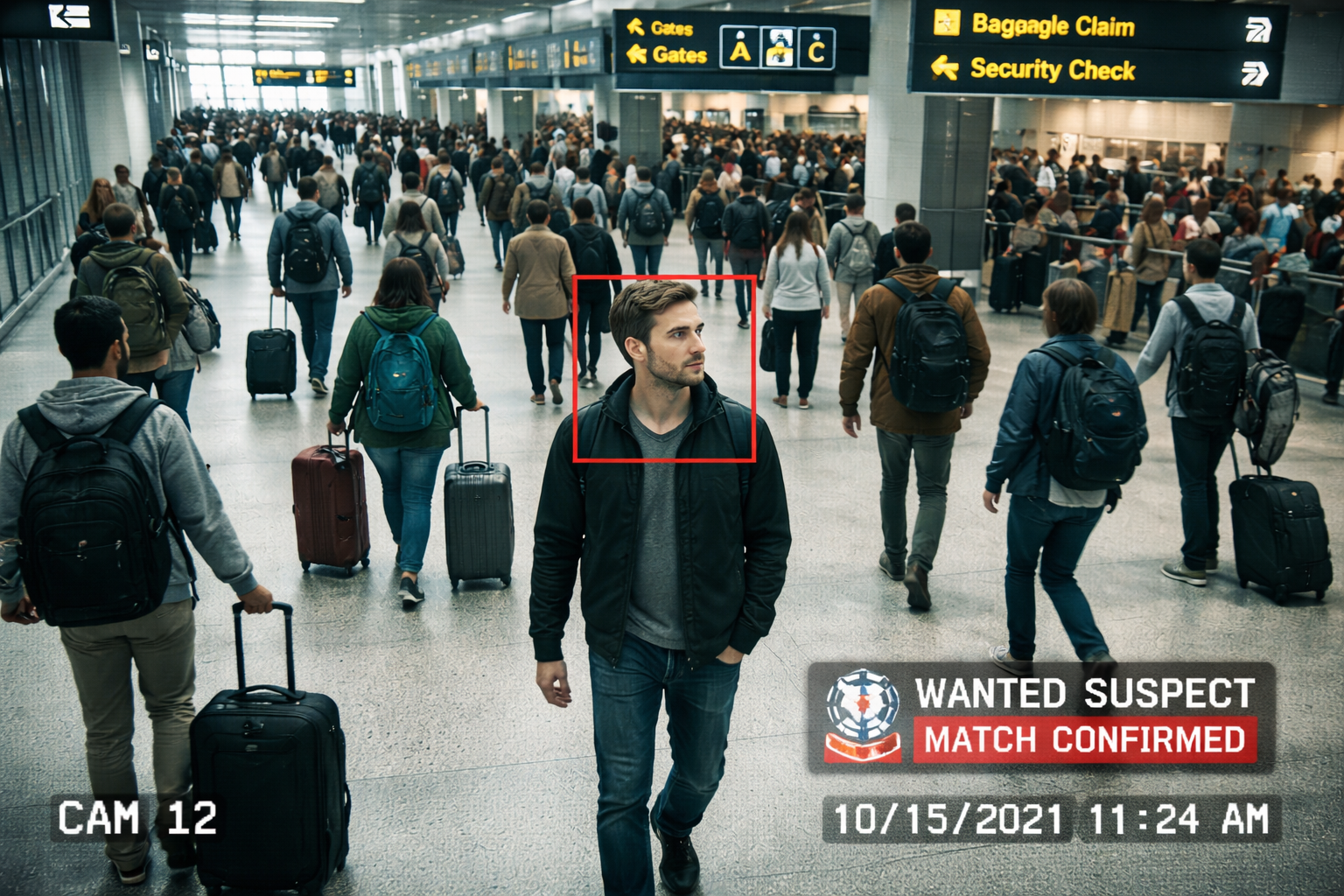
Why Airports Need On-Premises AI
Airport security data is among the most sensitive a government processes. Passenger lists, biometric data, watchlist matches — all are subject to aviation security regulations, national data protection laws, and bilateral agreements between countries. Cloud-based AI surveillance creates a chain of custody that crosses jurisdictions and exposes data to third-party operators.
Police.live processes all facial recognition on-premises inside the airport, on dedicated AI hardware. Frames, biometric templates, and match results are processed and stored on-premise — cloud reporting is optional and can be disabled for air-gapped sites. This addresses the single largest objection most aviation regulators have to AI-driven surveillance.
Detection & Matching Capabilities
Police.live performs facial detection and matching across all connected airport cameras in real time:
- Watchlist matching — match faces against agency-provided watchlist databases (Interpol, national criminal databases, internal hot-lists)
- Multi-camera tracking — follow a person of interest across terminals, gates, and access-controlled zones
- Crowd-density face detection — identify and process hundreds of faces per minute in high-throughput zones
- Quality-scored captures — automatic selection of the highest-quality face image from a sequence for evidentiary use
- Age and demographic estimation — for analytics and reporting (not used for matching decisions)
- Mask and face-cover detection — alert on individuals concealing identity in security-sensitive areas
- Watchlist enrollment workflow — secure ingestion of new watchlist entries with audit logging
Operational Workflow
When Police.live identifies a watchlist match, the workflow is designed for fast, accountable response:
The match alert appears on the operations console (O-R3) with the captured face, the matched watchlist entry, the camera location, and the AI confidence score. The operator confirms the match visually before dispatching response. All actions — alert, view, confirmation, dispatch — are timestamped and logged for audit.
Critical alerts can route automatically to specific operator stations, dispatch radios, or external systems via the Police.live API — enabling immediate response without operator-to-operator handoff delays.
Privacy & Bias Mitigation
Airport facial recognition is rightly subject to scrutiny over accuracy across demographics and protection of innocent passengers. Police.live is built with these concerns in mind:
- Configurable confidence thresholds — agencies set the minimum match score per use case
- No identification of non-matched faces — passengers not on watchlists generate no identification record
- Configurable retention — face captures expire automatically per agency policy (typically 24-72 hours for non-matches)
- Full audit logging — every match, view, and disposition is traceable to a named operator
- Bias testing reports available — AI model performance broken down by demographic for transparency
Integration with Airport Security Systems
Police.live integrates with the broader airport security ecosystem via REST API and WebSocket:
- PSIM platforms (e.g., AVA, Vidsys, NICE) — alerts route into your existing situation management
- Access control systems — link face matches to door access events for coordinated incident response
- Border control / immigration systems — match against agency-specific watchlists with proper authorization
- Computer-aided dispatch (CAD) — automatic ticket creation on critical matches
- Records management — incident reports auto-populate from match events